

Life is unpredictable. One day feels calm, and the next day brings a health scare, a stressful commute, or worry about your family’s safety. Many people across the USA are turning back to faith for comfort during hard times. This is where duas for protection come in. These simple prayers come straight from the Quran and the Sunnah. They offer real comfort, spiritual strength, and a sense of safety no matter what life throws your way.
This guide walks you through five of the most powerful protection duas. You will learn the Arabic text, the meaning, and the best time to recite each one. You will also learn special duas for your home, your children, and your travels. By the end, you will have a simple daily habit that brings peace to your heart and protection to your life.
What is Dua and Why is It Important for Protection
Dua simply means calling out to Allah. It is not a formal ritual like the five daily prayers. It is a personal, honest conversation with your Creator. You can make dua in English, Arabic, or any language you speak. The heart matters more than the exact words used. This is part of what Islam calls servanthood to Allah, a quiet acknowledgment that you need help beyond your own strength.
Protection duas matter because life brings real dangers. Illness, accidents, and fear are part of the human experience. Muslims believe that safety does not come from luck alone. It comes from sincere prayer paired with sensible action. Reciting Islamic prayers for safety builds a habit of turning to Allah first, before panic or worry take over.
The Importance of Protection (Hifazat) in Islam
Hifazat is the Arabic word for protection or safeguarding. It is a core part of daily Muslim life, not a side topic. The Quran reminds believers again and again that Allah hears every call. In Surah Ghafir, Allah says, “Call upon Me, I will respond to you.” This verse gives comfort to anyone facing faith in difficult times, showing that prayer is never wasted effort.
Islam teaches that everything happens through Allah’s divine wisdom and will. This does not mean believers should sit back and do nothing. Instead, they are taught to combine trust in Allah with real effort to stay safe. The Prophet Muhammad, peace be upon him, recited protection duas daily. He taught his companions to do the same, especially during dua for hardship and difficulty, whether facing illness, travel, or uncertainty.
Dua for Safety and Protection
Before looking at the five main duas, it helps to understand the bigger picture. Safety-focused prayers generally fall into a few groups. Some protect the body from physical harm. Others guard against illness. Some duas shield a person from evil eye or jinn. Others focus on the home, children, or travel.
You do not need to memorize every prayer at once. Start small and build slowly. Reciting even one dua daily with sincerity is far better than trying to memorize all five and giving up. Over time, these prayers become part of your morning and evening habit, giving you steady comfort no matter what the day brings.
5 Powerful Duas for Protection
These five duas come from authentic hadith collections. Each one focuses on a different kind of protection, so together they cover almost every situation you might face. They are considered part of the wider prophetic supplications that Muslims have recited for over a thousand years.
The table below gives a quick summary of all five duas, followed by the full Arabic text, transliteration, and meaning for each one.
| Number | Dua Name | Main Purpose | Source |
| 1 | Protection Against Every Kind of Harm | General safety from harm | Sunan Abi Daud |
| 2 | Seeking Forgiveness and Well-Being | Forgiveness and dua for well-being | Sunan Ibn Majah |
| 3 | Total Protection | Full-body, all-direction safety | Sunan Ibn Majah |
| 4 | Protection from Every Evil | Shield from all created evil | Sahih Muslim |
| 5 | Protection from Diseases | Protection from diseases and illnesses | Sunan Abi Daud |
1. Dua for Protection Against Every Kind of Harm
This dua calls on the name of Allah as a shield against protection from harm, whether on earth or in the sky above.
بِسْمِ اللَّهِ الَّذِي لَا يَضُرُّ مَعَ اسْمِهِ شَيْءٌ فِي الْأَرْضِ وَلَا فِي السَّمَاءِ وَهُوَ السَّمِيعُ الْعَلِيمُ
Transliteration: Bismillahil-lazi la yadhurru ma’asmiHi syai’un fil ardhi wa la fis-sama’i wa Huwas-Sami’ul ‘Aleem
Meaning: In the name of Allah, with whose name nothing on earth or in heaven can cause harm, and He is All-Hearing, All-Knowing.
2. Dua to Seek Forgiveness and Well-Being
Short and easy to remember, this dua asks for a safety and forgiveness dua in one single line.
اللَّهُمَّ إِنِّي أَسْأَلُكَ الْعَفْوَ وَالْعَافِيَةَ فِي الدُّنْيَا وَالآخِرَةِ
Transliteration: Allahumma inni as’alukal-‘afwa wal ‘afiyah fid-dunya wal-akhirah
Meaning: O Allah, I ask You for pardon and well-being in this world and the hereafter. This prayer touches on protection in this world and hereafter, covering both present safety and future peace.
3. Dua for Total Protection
This is known as the total protection dua because it covers every direction, front, back, sides, above, and below.
اللَّهُمَّ احْفَظْنِي مِنْ بَينِ يَدَيَّ, وَمِنْ خَلْفِي, وَعَنْ يَمِينِي, وَعَنْ شِمَالِي وَمِنْ فَوْقِي, وَأَعُوذُ بِعَظَمَتِكَ أَن أُْغْتَالَ مِنْ تَحْتِي
Transliteration: Allahummah-fazni min baini yadaiya, wa min khalfi, wa ‘an yameeni, wa ‘an syimali wa min fauqi, wa a’uzu bi’azomatika an ughtala min tahti
Meaning: O Allah, guard me from ahead, behind, my right, my left, and above, and I seek refuge in Your greatness from being seized unaware from below.
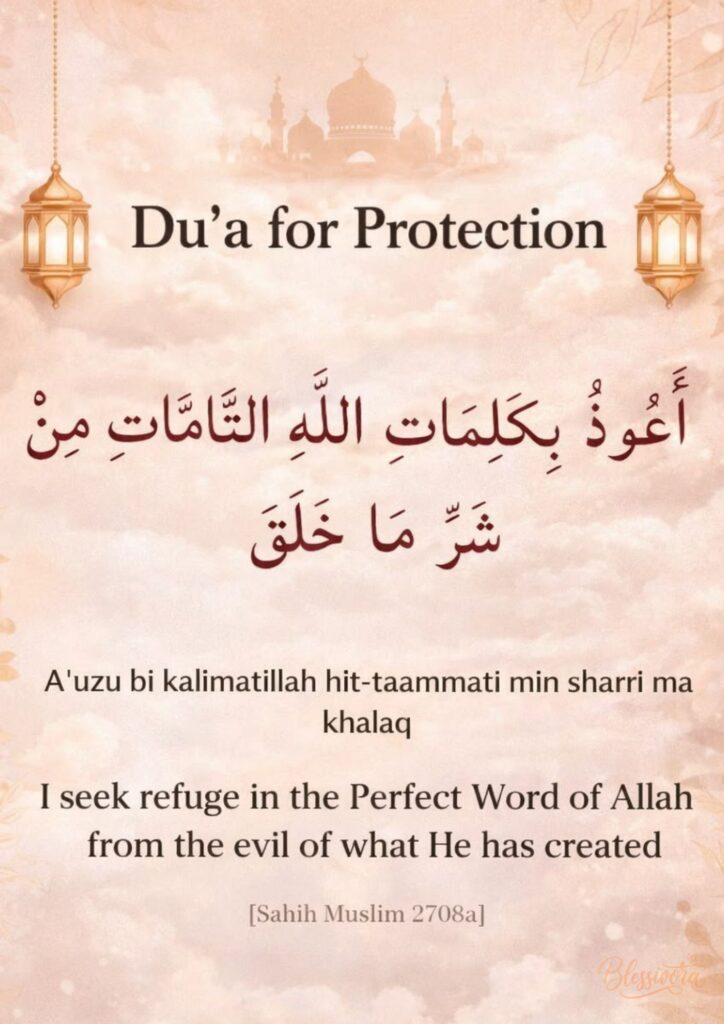
4. Dua for Protection from Every Evil That Brings Harm
This short but powerful line asks for seeking refuge in Allah from any evil that exists in creation.
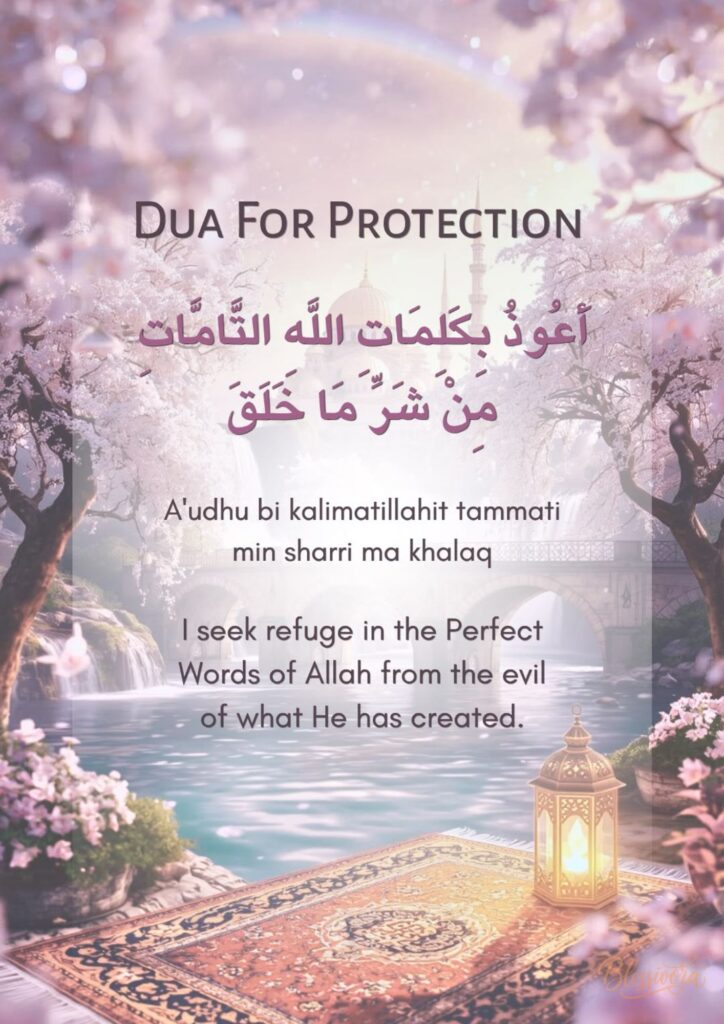
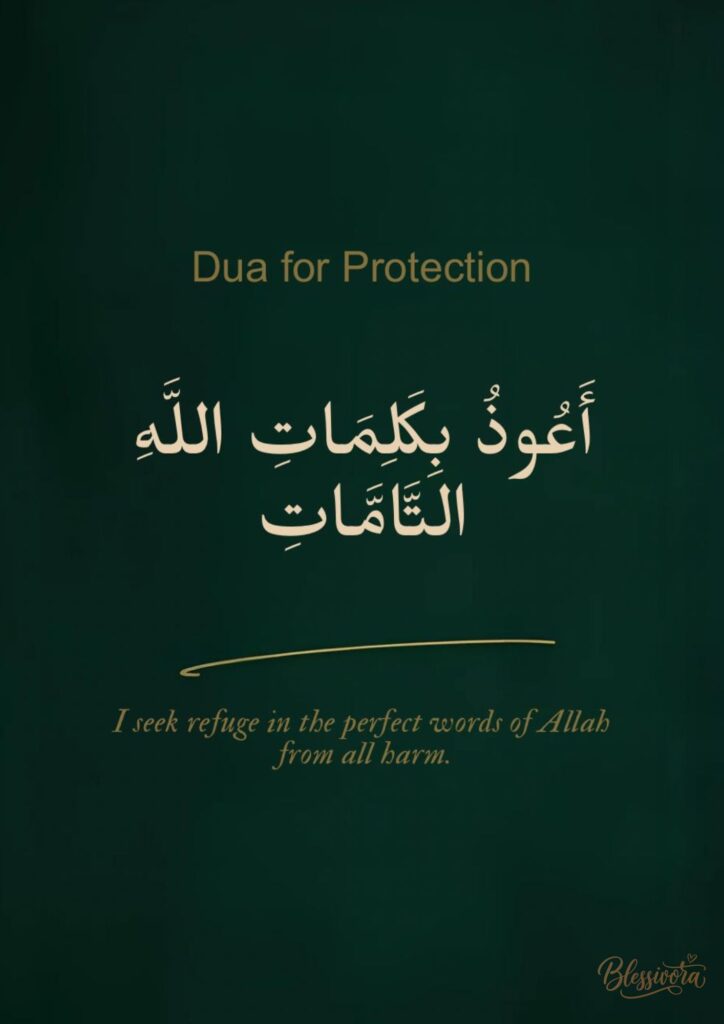
أَعُوذُ بِكلِمَاتِ الله التّامّاتِ مِن شَرّ مَا خَلَقَ
Transliteration: A’uzu bikalimatillahit-tammaati min syarri ma kholak
Meaning: I seek refuge in the perfect words of Allah from protection from every kind of evil that He has created.
5. Dua for Protection from Diseases
This dua names specific illnesses and is a well-known dua for the sick, offering comfort during health struggles.
اللَّهُمَّ إِنِّي أَعُوذُ بِكَ مِنَ الْبَرَصِ، وَالْجُنُونِ، وَالْجُذَامِ، وَمِنْ سَيِّئِ الأَسْقَامِ
Transliteration: Allahumma inni a’uzubika minal baros, wal junuun wal juzam, wa min sayyi’-il-asqam
Meaning: O Allah, I seek refuge in You from leprosy, madness, elephantiasis, and evil diseases. Scholars often list this among the healing and recovery duas recommended for anyone facing sickness.
Arabic Text, Translation, and Virtues of Each Dua
Reciting the Arabic text carries special weight in Islamic tradition. The words themselves come from prophetic tradition (Sunnah), passed down through trusted chains of narration. Reading the Arabic connects you directly to how the Prophet Muhammad himself spoke these words centuries ago.
Understanding the translation matters too, especially for those still learning Arabic. Knowing what each phrase means turns simple repetition into heartfelt prayer. A person reciting words they do not understand may still benefit, but understanding adds depth and sincerity. Many teachers recommend learning the meaning first, then practicing the Arabic pronunciation slowly over time.
When and How to Recite These Duas
Timing plays a real role in Islamic prayer life. Morning and evening duas are especially recommended, often right after Fajr prayer and again before Maghrib. These two windows are considered spiritually powerful moments for protection and reflection.
That said, do not wait for a perfect moment to pray. Reciting these prayers during a car ride, before a work meeting, or right before bed all count as valid daily supplications. What matters most is consistency. A short dua repeated daily brings more benefit than a long prayer said only once in a while.
Special Duas for Protecting Home, Children, and During Travel
Family safety is often the biggest worry for busy households across America. Simple habits, like reciting a dua before leaving the house or before a road trip, can bring real comfort. Many parents also teach short protection duas to their children, turning bedtime into a moment of both safety and connection.
Travel duas hold special value for anyone who flies often or drives long distances for work. A short prayer said before starting the car or boarding a plane takes only seconds but brings lasting peace of mind. These small acts of faith fit easily into a busy American lifestyle without requiring extra time or effort.
Duas for Protection from Evil Eye and Jinn
Evil eye, known as nazar, refers to harm caused by envy or jealousy directed at a person. Many cultures across the world share a version of this belief, and Islam offers a clear spiritual response. Reciting a dua for evil eye protection regularly is one of the most common practices among Muslim families worldwide.
Jinn are unseen beings mentioned directly in the Quran, and Muslims are taught to seek shelter from any harm they may cause. Surah Al-Falaq and Surah An-Nas are two short chapters specifically recited for this purpose. Combining these chapters with the five duas above builds a strong daily shield against unseen harm.
Frequently Asked Questions
What is the dua for protection from harm?
The dua starting with “Bismillahil-lazi la yadhurru” is one of the most well-known prayers for general protection from harm, covering both earth and sky.
How do you ask Allah for protection?
You simply speak honestly, asking Allah directly for safety, either in your own words or using one of the well-known prophetic duas listed in this article.
What dua protects you from evil?
The dua “A’uzu bikalimatillahit-tammaati min syarri ma kholak” is specifically recited for protection from all forms of created evil.
What is the Islamic prayer for safety?
There is no single fixed prayer, but the five duas shared in this article are among the most trusted prayers for daily safety.
Conclusion
Building a habit around these five prayers brings lasting comfort. Combining sincere prayer with sensible precautions and spiritual protection gives you both peace of mind and practical safety in daily life. This balance reflects the heart of Islamic teaching, trusting Allah while still taking responsible action.
Strengthening faith through prayer does not require perfection. Start with one dua, recite it daily, and let it grow into a habit over time. Whether you are facing illness, travel, or simple daily stress, these prayers offer refuge from harm and hardship in a way that feels both simple and deeply meaningful.